Advertising Flyer Banner on Stand Up: A Practical Guide to Effective Visual Promotion
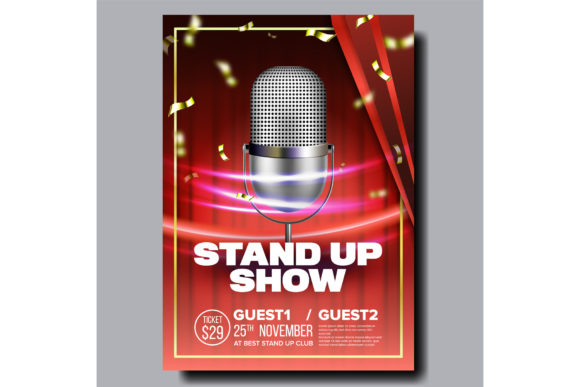
The Advertising Flyer Banner on Stand Up is a powerful visual tool that combines striking imagery with concise messaging to capture attention and communicate key information. Designed for use in promotional campaigns, events, or brand awareness initiatives, this type of banner leverages elements like a silver old microphone, speed movement lights, golden confetti, and a red curtain background to create an engaging and dynamic scene. Whether you're promoting a concert, launching a product, or advertising a service, the right flyer banner can serve as a cornerstone in your marketing strategy.
What Is an Advertising Flyer Banner on Stand Up?
An Advertising Flyer Banner on Stand Up is typically a high-resolution design (available in formats such as JPG and EPS) used to promote events or products through eye-catching visuals. It often features a comical or dramatic representation of a performance, usually centered around a stand-up event — think comedy shows, musical performances, or motivational speaking engagements. The design includes realistic 3D illustrations to add depth and realism, making it ideal for both digital and print media.
This kind of banner is especially effective because it tells a story quickly. The red curtain background evokes a stage setting, while the silver microphone and golden confetti suggest celebration and entertainment. These symbolic elements work together to draw the viewer's eye and convey a sense of energy and excitement without the need for lengthy explanations.
Where Does This Banner Fit Into Your Marketing Workflow?
Understanding where to place the Advertising Flyer Banner on Stand Up within your broader marketing process is essential for maximizing its impact. Here are several stages where it can play a role:
- Pre-Event Planning: Use the banner during the initial promotion phase to generate buzz. It can be shared on social media, embedded into email campaigns, or printed for physical distribution at local venues.
- During the Event: Display the banner at the event entrance or backstage area to reinforce branding and set the tone for attendees.
- Post-Event Follow-Up: Repurpose the banner for thank-you messages, testimonials, or announcements about future events.
By integrating the banner at these different points, you maintain a consistent visual presence that supports your overall campaign goals. Its versatility allows it to adapt to various formats and platforms while still delivering a strong message.
How to Use the Advertising Flyer Banner on Stand Up in Different Scenarios
Whether you're managing a large-scale event or promoting a small business launch, the Advertising Flyer Banner on Stand Up can be tailored to suit your needs. Here are some practical use cases:
Promoting a Live Performance
If you’re organizing a live show — whether it’s a music gig, a comedy night, or a theater production — the banner acts as a central piece of your promotional materials. You can:
- Share it on Facebook Events and Instagram Stories to attract younger audiences.
- Print it for distribution in cafes, bars, and community centers near your venue.
- Use it as part of a countdown series leading up to the event.
Its 3D illustration style gives it a premium look that stands out from generic text-based ads. This helps build anticipation and makes your event more memorable.
Supporting a Product Launch
In a product launch scenario, the banner can be used creatively to simulate a presentation or demonstration. For example:
- Feature the banner on your landing page as a visual headline to highlight the main selling point.
- Embed it in a video script showing a mock press conference or keynote speech.
- Send it as a digital postcard to your mailing list to introduce the new offering in a fun, engaging way.
Its theatrical background and energetic visual cues help position the product as something worth celebrating, aligning well with the excitement of a launch.
Enhancing Brand Visibility at Trade Shows
At trade shows or conferences, having a standout visual is crucial. The Advertising Flyer Banner on Stand Up can be printed on a stand or displayed on a screen to:
- Draw attendees to your booth.
- Highlight a special offer or featured presentation.
- Complement other signage by creating a cohesive theme.
Because it's designed to be viewed from a distance, it ensures your message remains visible and compelling even in crowded environments.
Integration with Other Tools and Resources
To get the most value from your Advertising Flyer Banner on Stand Up, it should be integrated into your existing marketing tools and workflows. Here’s how:
Pairing with Social Media Campaigns
Use the banner as a focal point for your social media posts. Trim parts of the design to create smaller images for Twitter, LinkedIn, or Pinterest. Since it’s available in vector format (EPS), you can easily edit and resize it without losing quality, ensuring it looks sharp on every platform.
Combining with Email Marketing
Email campaigns benefit greatly from strong visuals. Insert the banner as a header image in your newsletters to grab attention immediately. You can also animate parts of the banner using GIF tools or embed it in a slide deck if you’re hosting a webinar or online presentation.
Working Alongside Print Materials
If you're producing brochures, posters, or flyers, the Advertising Flyer Banner on Stand Up can be adapted to match those designs. Its bold colors and clear layout make it easy to repurpose for complementary print assets. Just ensure consistency in fonts, color schemes, and branding across all materials for a unified look.
Practical Tips for Implementation
Here are some actionable tips to help you implement the Advertising Flyer Banner on Stand Up effectively:
- Plan Ahead: Decide early on which platforms and formats you’ll use the banner for. This will guide your design choices and file preparation.
- Optimize for Clarity: Ensure the text is legible from a distance and that key elements like the microphone and confetti don’t overwhelm the message.
- Test Across Devices: Before finalizing the design, preview it on different screens and printers to confirm compatibility and quality.
- Stay Organized: Keep versions of the banner labeled clearly (e.g., "Banner_StandUp_SocialMedia" or "Banner_StandUp_Print") to streamline reuse and avoid confusion later.
When working with vector files (EPS), always keep a copy of the original source so you can make edits without degradation. This is especially useful if you need to update event details or rebrand over time.
Workflow Examples
Let’s look at two workflow examples to illustrate how the Advertising Flyer Banner on Stand Up fits into real-life scenarios:
Example 1: Music Festival Promotion
Phase 1 – Pre-Event: Create a full-size version of the banner to use on the festival website and in email invites. Extract the microphone graphic for use in promotional videos. Phase 2 – During the Event: Print the banner for display at the entrance and on speaker stands. Share behind-the-scenes photos of the banner setup on Instagram. Phase 3 – Post-Event: Update the banner with the event date and include a “See You Next Time” message. Send it as a thank-you card to attendees via email.
Example 2: Startup Pitch Presentation
Phase 1 – Preparation: Design the banner to feature the CEO holding the silver microphone on a red curtain backdrop. Include a tagline that reflects the startup’s mission. Phase 2 – Execution: Use the banner as the opening slide in a pitch deck. Print it for handouts at investor meetings. Phase 3 – Follow-Up: Convert the banner into a downloadable PDF for your website. Offer it as a lead magnet in exchange for contact information.
Factors to Consider for Long-Term Success
Creating and using the Advertising Flyer Banner on Stand Up isn’t just about aesthetics — it’s about building a sustainable marketing asset. Here are some factors to keep in mind:
- Preparation: Define your target audience, message, and desired outcome before designing the banner. This ensures the content is aligned with your goals.
- Compatibility: Choose the right file format based on your usage. Use JPG for web and EPS for print or scalable digital use.
- Usability: Make sure the banner is adaptable. Can you change the text? Resize it for mobile screens? Modify the lighting effects for nighttime events?
- Organization: Store the banner in a centralized asset library along with related content. This makes it easier to access and update when needed.
- Efficiency: Use templates or pre-built versions of the banner to save time during future campaigns.
- Consistency: Align the banner with your brand guidelines to maintain a professional appearance across all channels.
- Quality Control: Always review the final output before printing or publishing. Check for resolution, alignment, and clarity.
- Long-Term Use: Think about how the banner can evolve. Will it be reused for similar events? Can it be modified for different markets or themes?
By considering these aspects upfront, you reduce the risk of errors and increase the likelihood of the banner being a valuable asset for years to come.
Final Observations
The Advertising Flyer Banner on Stand Up is more than just a one-time graphic; it’s a strategic component of your visual storytelling toolkit. When executed thoughtfully, it can boost engagement, reinforce your brand identity, and simplify your promotional efforts. The inclusion of realistic 3D elements, like the silver microphone and golden confetti, adds a layer of professionalism and creativity that resonates with diverse audiences.
Creators and marketers who understand how to integrate this banner into their workflows gain a competitive edge. They know how to leverage its components for multiple uses and how to adapt it to changing needs. As a result, they achieve better outcomes while maintaining efficiency and brand consistency.
Whether you're using it to announce a grand opening, promote a talk, or market a product, the Advertising Flyer Banner on Stand Up offers a unique blend of artistry and utility. With careful planning and smart execution, it can become a vital part of your visual communication strategy.